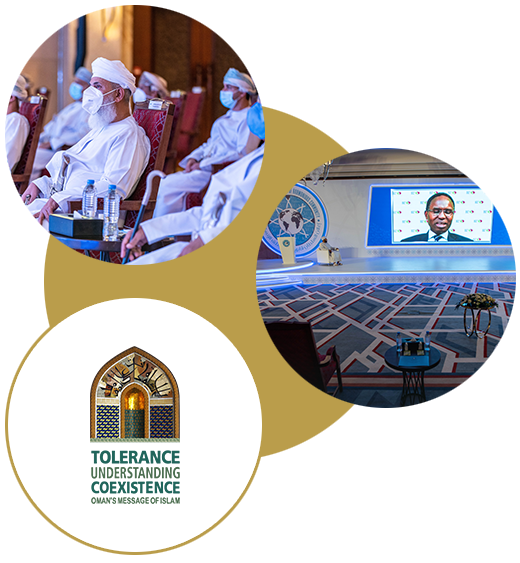
In 1996, the UN General Assembly invited Member States to observe November 16 as the (International Day of Tolerance) to promote mutual acceptance and peaceful coexistence, both among different communities and groups, through “activities in the scientific, cultural, and artistic or communication fields.” To commemorate this Day, and to emphasize the role of (Sultanate of Oman’s Message of Islam) project in spreading the Sultanate of Oman’s message of peace and harmony, and its approach for tolerance, understanding and coexistence, the Ministry of Endowments and Religious Affairs in Oman, in collaboration with the Network for Religious and Traditional Peacemakers, will organize two celebratory events on Tuesday, November 16, and Wednesday, November 17, 2021.
The automated process starts as soon as your clothes go into the machine. Duis cursus, mi quis viverra ornare, eros dolor interdum.
This year’s International Day of Tolerance comes at a time of crisis for humanity. To date, the COVID 19 pandemic has cost over 5 million lives, devastated the global economy, and upended all spheres of human life. The pandemic has further exacerbated poverty and inequality, including the impacts on women, girls and marginalized communities and groups. These groups have been disproportionately more impacted, losing their livelihoods faster and facing greater health risks because of the existing political, social, and economic inequalities. According to the UN Secretary-General, the social and economic impact of the pandemic is enormous and growing, “no vaccine can undo the damage already done. The damage will stretch across the years and decades to come.” All these impacts have further deepened mistrust and division within communities and multi-lateral institutions.
At the same time, the crisis has also highlighted the importance of solidarity and collaboration, with greater investment in social protection, health care, education, and livelihoods. Additionally, the pandemic has shed further light on the value of empowering local actors, including religious actors, women, and youth, who have been at the forefront of various initiatives.
Such progress is only feasible within an environment that fosters tolerance and mutual understanding among cultures and peoples. Hence, this year’s International Day of Tolerance is more important than ever. The UN 2030 Agenda and its 17 Sustainable Development Goals (SDGs) can only be realized through mutual understanding and coexistence, drawing upon creative solutions and contributions of diverse communities and groups, and leveraging their comparative capacities and ingenuity to ensure the 2030 Agenda is responsive to the needs of every segment of society.
On the first day, the topic of the “Importance of Promoting Values of Tolerance in Communities in Times of Crisis” will be highlighted with a focus on the global crisis caused by the Corona pandemic (Covid 19). On this day, religious and other institution actors will highlight their role in supporting and protecting the principles of tolerance and human rights during times of crisis.
Under the theme (Role of Science and Scholars in Promoting Values of Tolerance in Times of Crisis) a roundtable with religious actors, faith-based institutions, and community leaders will be convened, exchanging views, experiences and measures they have taken to effectively promote tolerance in times of crisis and reflect on their contributions to the United Nations 2030 Agenda. The UN mentions 5-factors in the fight against intolerance: law, education, access to information, individual awareness, and local solutions.
On the second day, the topic (Importance and Role of Societies and Organizations in Mitigating Covid-19 Consequences) will be highlighted, with a focus on efforts of individuals, organizations, and institutions in various societies. The day will host local and global representatives from various sectors.
On the second day, an interactive presentation titled (Whole of Society Approach: Shining Examples of Mitigating COVID-19 Consequences) will bring together actors from the UN and its Member States, civil society, and multi-religious spaces to share best practices and mechanisms they have adopted in their local context to promote peace and inclusion amid the COVID-19 pandemic with examples centering around promoting vaccine equity, uptake and countering misinformation and hate speech.

© 2021 Tolerance Day. All Rights Reserved.